 CUISINE
 HISTORY
 JOURNALS
 PEOPLE
 CONSERVATION
Black Gold
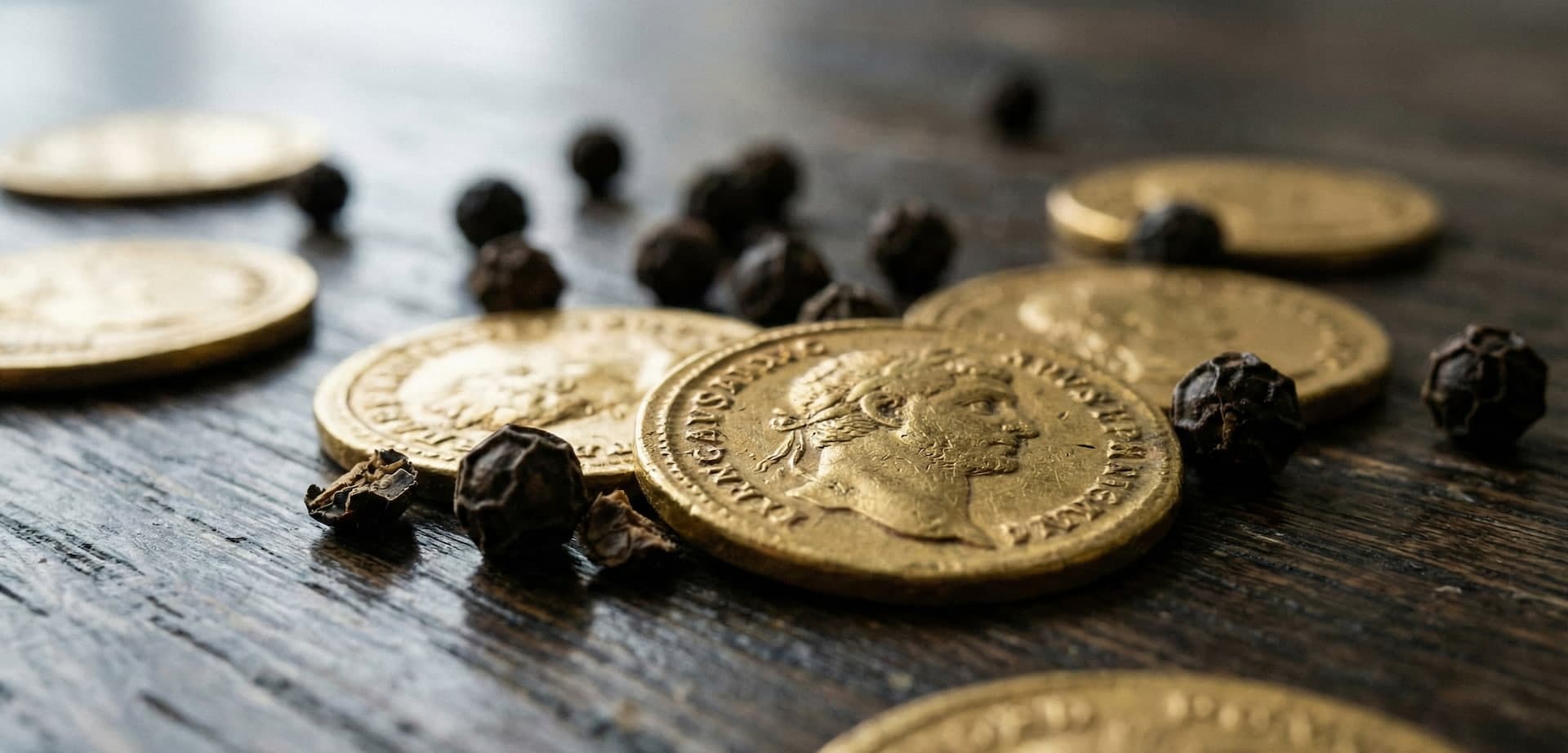
There was a time when a small wrinkled berry from the forests of Kerala could bend the spine of an empire. Black pepper. Not merely a spice, not merely a seasoning crushed between fingers. It was breath and fever and appetite. It was what the Romans called luxury and what the Malabar called ordinary life. It grew quietly on vines that climbed jackfruit trees and silver oaks, listening to monsoon rain, unaware that in faraway Rome senators argued over its scent. By the first century CE, ships from the Mediterranean crossed the Arabian Sea, riding the monsoon winds described in the Periplus of the Erythraean Sea. They came for pepper from Muziris, the ancient port believed to have stood near today’s Kodungallur. They came with gold. Pliny the Elder wrote in 77 CE, in his Natural History, that India was draining the Roman Empire of its wealth. He complained that Rome was sending vast amounts of gold eastward for luxuries that weakened Roman virtue. He called India a sink of the world’s gold. He was irritated by pepper. He thought it unnecessary, indulgent. And yet Rome could not stop craving it. Roman senators debated restrictions on luxury imports. Some argued that gold flowing to India weakened the empire’s economic spine. But prohibition is a poor match for desire. Pepper continued to move in sacks across oceans. Roman coins continued to move in chests toward Kerala. Archaeologists have found thousands of Roman aurei and denarii across Tamil Nadu and Kerala, especially near the Kaveri river delta. At places like Karur and in the broader Cauvery basin, hoards of Roman coins surfaced from the soil, often with small cuts or chisel marks. These were test marks. Merchants in South India sliced into the coins to verify that the gold was pure and not plated fraud. Trust was measured with a blade. Kerala, it seems, had little interest in Roman goods. Amphorae of wine and olive oil arrived, yes. Glassware too. But the balance of trade leaned heavily eastward. What Rome truly offered was gold. And gold was accepted not as submission, but as price. In 2011, when vaults of the Padmanabhaswamy Temple were opened in Thiruvananthapuram, the world stared in disbelief. Gold coins, ornaments, jewels, artifacts accumulated across centuries were found in staggering quantity, with estimates reaching around twenty two billion dollars in value. Among them were coins bearing foreign faces, echoes of long dissolved empires. History sleeping in darkness. Trade turned into devotion. Was Roman hunger for pepper the seed of colonial ambition centuries later. Not directly in a single straight line. The Roman Empire did not colonise Kerala. But the pattern was planted early. Europe’s appetite for spices never faded. When overland routes became unstable and intermediaries controlled trade, European powers searched for sea routes. The voyages of the Portuguese at the end of the fifteenth century were driven by spice. Pepper was no longer seasoning. It was strategy. Vasco da Gama did not sail to India out of curiosity alone. He sailed because black pepper was worth war. What Rome once paid for in gold, later Europe tried to control with cannons and forts. The Portuguese, then the Dutch, then the British. Colonialism was not born from pepper alone, but pepper was one of its most fragrant excuses. And yet not everything was taken back. Some gold remained, sealed in temple vaults. Some coins stayed buried in riverbeds. Some colonial bungalows survived on hill slopes, their fireplaces still cold with memory. At places like The Hundred House in Wayanad, time feels layered. You can almost imagine a Roman coin pressed into a landlord’s palm, then centuries later a British planter counting wages under a tiled roof while pepper vines climbed outside. Black gold moved empires. It crossed oceans without a passport. It made senators anxious and sailors wealthy. It turned Kerala into a whisper in Roman halls. Today when pepper crackles in hot oil in a kitchen in Wayanad, it is easy to forget that this small dark bead once tilted the balance of the ancient world. It was counted alongside gold and silver not because it shone, but because it made people want more. Empires rise from desire. Sometimes all it takes is a taste.